The Power of Your “口癖” (Habitual Speech)
Have you ever stopped to consider what your automatic responses reveal about your results? In sports therapy, we often observe a clear divide between those who consistently achieve their desired outcomes and those who don’t. While many factors contribute to this, one subtle yet powerful difference lies in their habitual speech—their “口癖” (kuchiguse).
Your mouth is your most frequent communicator, and your ears are your closest listeners. These automatic phrases, often said without a second thought, create a powerful subconscious loop. When you utter a limiting belief, you’re not just making a statement; you’re setting a new trajectory—often dragging yourself toward a negative outcome.
At M3, our goal is to empower you to take positive steps toward better health. To help you become more conscious of these hidden obstacles, we’ve compiled a list of phrases we strongly discourage. These are the “Forbidden Phrases” that we believe hinder your progress the most.
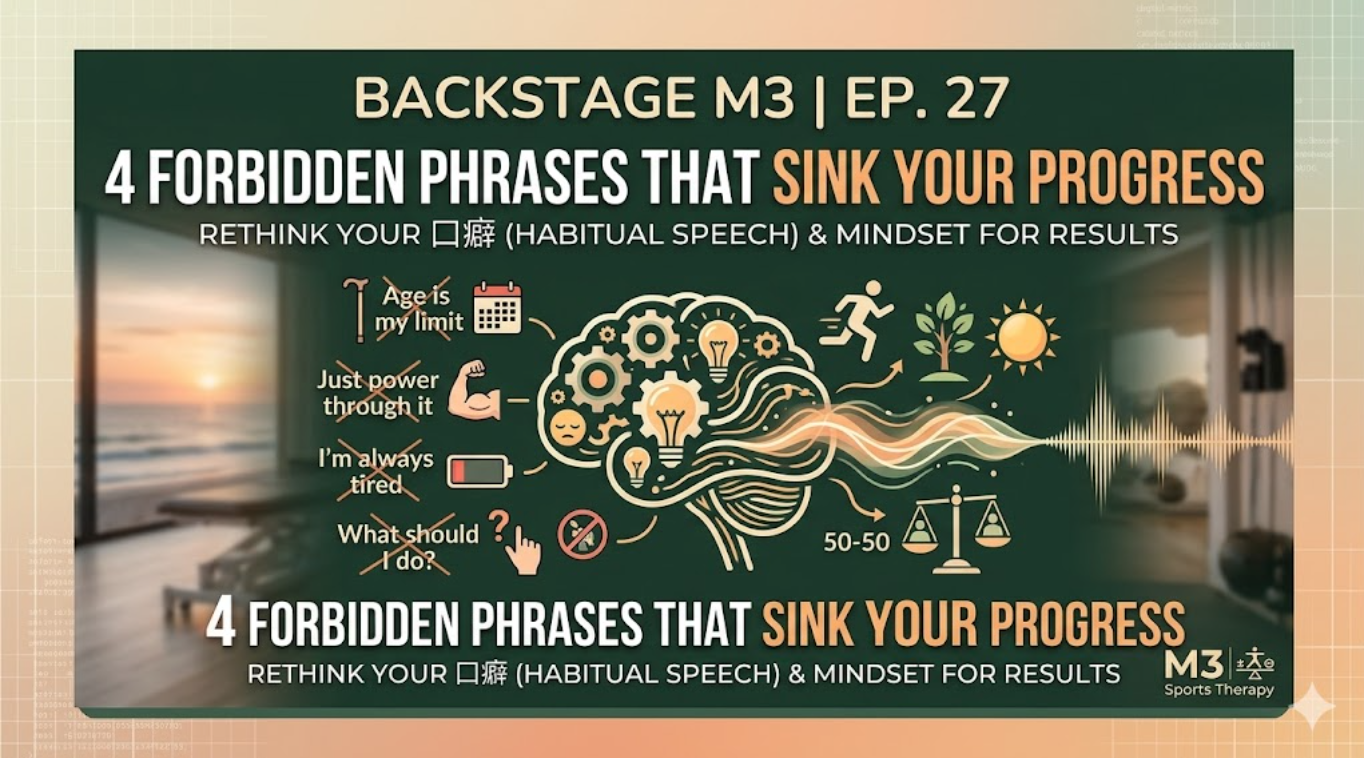
4 Forbidden Phrases (and Why to Lose Them)
1. “Because I’m a certain age…” / “It’s my age…”
Age is a numerical value, not a limitation. In sports therapy, we see this all the time. When you say, “I can’t do that because I’m old,” you are giving power to an external factor rather than taking responsibility for your own effort and consistency.
Here’s the reality: everyone ages. Yes, your body changes. But “my age” is not to blame for a lack of strength or mobility; a lack of purposeful movement and effort is. We see clients in their 60s, 70s, and 80s who are far more capable than people decades younger, all because they refuse to use age as an excuse. When you blame your age, you’re giving up your power.
Reframe: Focus on your current capabilities and build from there. Effort and purpose are ageless.
2. “I don’t have enough strength / stamina.”
This phrase, while perhaps factually correct in a comparative sense (e.g., “I used to run 5k, now I’m tired after 500m”), is often used vaguely to express perceived weakness or inability. It places a finite limit on your potential.
Our training isn’t about crushing personal records on a treadmill. It’s about optimizing efficiency—performing the same movement with less perceived effort. Performance isn’t just a number; it’s about movement quality, dynamic coordination, and synergistic action. Brute strength is necessary but over-relying on it is a pitfall. If your focus is only on “more strength,” you might be ignoring the precise motor control needed to prevent injury or perform fine motor skills.
Reframe: Focus on improving movement quality and coordination. Strength and stamina are byproducts of consistent, purposeful effort.
3. “Do it with brute force.” / “Just power through it.”
This mindset is linked to the previous forbidden phrase. Many people, particularly athletes, tend to rely on sheer power and force for all movements, even those requiring nuance and control. Brute force often leads to less efficient movement and increased risk of injury.
When you power through a movement that should be precise, you are masking underlying inefficiencies. If you can only lift your hand above your head by using brute force, you aren’t fixing the underlying mobility issue; you’re just bypassing it in a way that can lead to pain and injury. Your movement should be smooth and efficient, not a raw display of power at the wrong moment.
Reframe: Move with control, precision, and efficiency. Power has its place, but nuance is often more powerful in achieving long-term performance.
4. “What should I do?” / “I should…”
This is perhaps the most insidious forbidden phrase. It stems from a place of dependence and a need for an external “answer” rather than internal ownership. The very use of “should” implies an external obligation,我慢 (gaman – endurance), and lack of true motivation.
When you ask, “What should I do?“, you are abdicating responsibility to an expert (like us). Our goal is to guide you with hints, not to dictate a single “correct” answer. True growth comes when you seek clues, experiment with new movements, and integrate what works into your body. You’re looking for independent choice and critical thinking. We want a 50-50 relationship: you bring 100% of your effort to the 50% that is your action, and we bring 100% of our expertise to the 50% that is our guidance.
Reframe: Take ownership of your journey. Seek guidance, but find your optimal path forward. True growth is independent.
In Conclusion: Tune Into Your Kuchiguse
Your “口癖” can be your greatest ally or your biggest enemy. By becoming aware of the limiting phrases you use unconsciously, you can begin to make conscious changes. This isn’t about being perfectly positive; it’s about shifting your mindset from a state of limitation and dependence to one of potential and empowerment.
Tune into your habitual speech. When you hear yourself say a forbidden phrase, stop and ask yourself what true belief it reveals. Use that self-reflection to reframe your language and, ultimately, your results.