
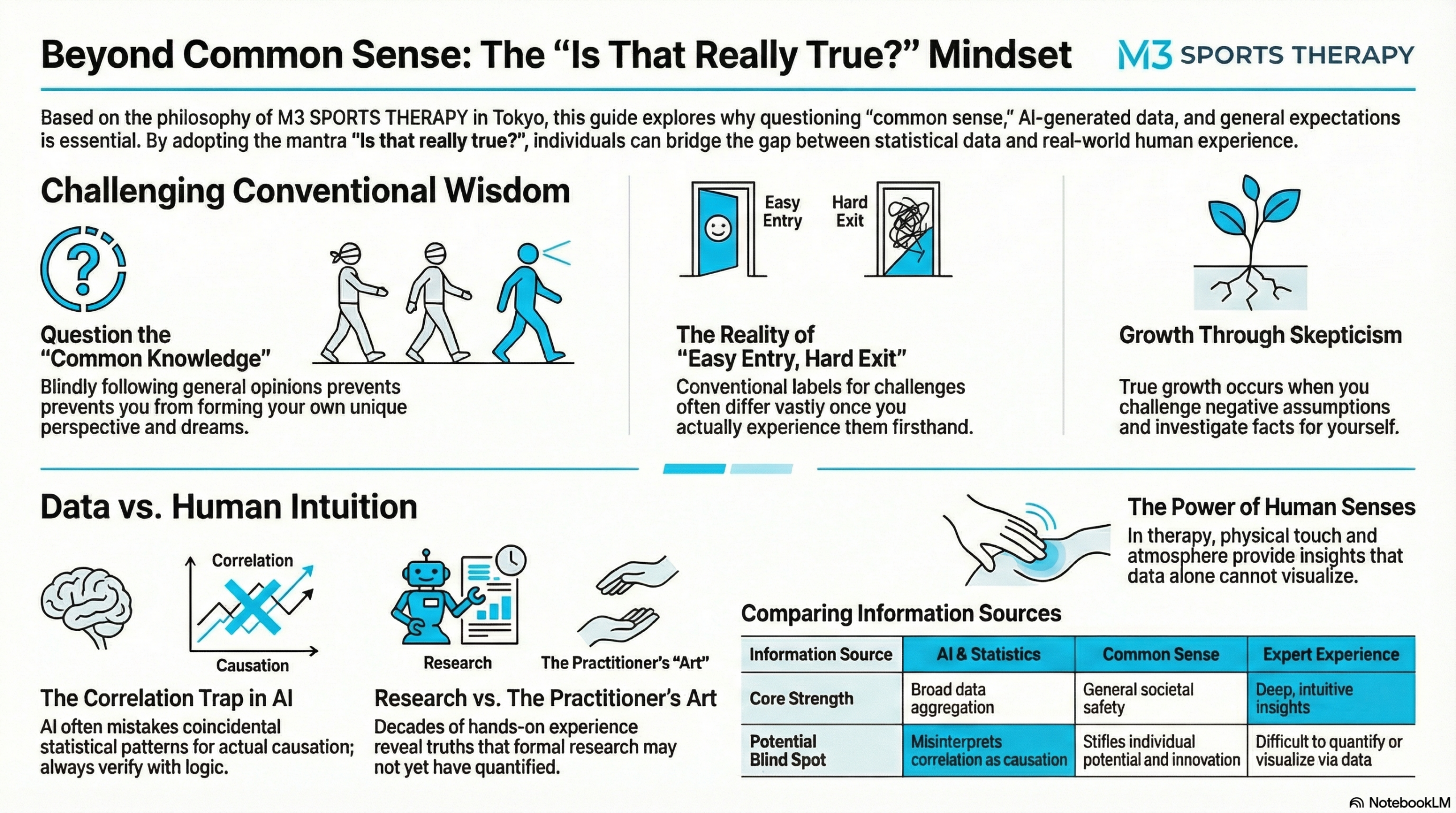
Every day, we are bombarded with information from schools, news, and social media. “Getting into American universities is easy, but graduating is hard.” “This food additive is bad for you.” These are often presented as “common sense” or facts. But are they absolute truths that apply to everyone?
we discussed the vital importance of asking the simple question: “Is that really true?”
1. Generalizations Are Just “Averages”
When I decided to go to college in the U.S. after high school, everyone warned me: “It’s easy to get in, but graduating is extremely difficult”. As someone who didn’t speak English and wasn’t a top student, this sounded like an impossible wall to climb.
But when I actually took the leap, I found the reality was different. Every university is different, and ultimately, you never know until you try. If I had swallowed the “general opinion” and given up before I started, my career as an athletic trainer would never have existed.
Information is often just statistics or other people’s experiences. Are you letting “general rules” categorize you and shut down your potential before you even begin?
2. Don’t Blindly Trust the Internet or AI
We live in a convenient era where smartphones and AI can answer almost anything. However, the answers AI provides are merely aggregates of past data and general opinions.
For example, if a graph showing an increase in food additives matches a graph showing an increase in a certain disease, AI might suggest a correlation. But that could be a complete coincidence, not a cause-and-effect relationship.
It is dangerous to feel like you “know” something just because you saw data on a screen. The “truth” you gain through your own actual experiences and physical sensations is the only answer that truly matters for you.
3. The Power of “Who Says It”
Interestingly, how we receive advice depends heavily on who is giving it. Words from someone we trust or respect sink in deeply, while the same words from someone else might bounce right off.
However, sometimes a single comment from someone you don’t get along with, or someone completely different from you, can be the key to breaking out of your shell. Growth points are often hidden not just in conversations with close friends, but in dialogues with people who challenge your worldview.
Conclusion: Doubt is the First Step to Growth
“Humans cannot survive without eating” is common sense. Yet, there are stories of monks who supposedly live on air (whether true or not, the possibility challenges our understanding).
Are the habits or limits you accept as “normal” truly unchangeable? “Is that really true?” By asking yourself this question, you might find a new path or a better way of doing things. Start updating yourself today by placing a small question mark over your daily routine.
【それ本当か?】常識を疑う力が、あなたの可能性を広げる理由
私たちは日々、学校教育やニュース、SNSを通じて膨大な情報に触れています。「アメリカの大学は入るのは簡単だが、出るのは難しい」「この食品添加物は体に悪い」……。これらは一般的に「常識」や「事実」として語られていますが、果たしてそれはすべての人に当てはまる真実なのでしょうか?
「それ本当か?」と常に疑問を持つことの重要性についてです
1. 「一般論」はあくまで「他人の平均値」
私が高校卒業後、アメリカの大学へ行くと決めた時、周囲からは「入るのは簡単だけど、卒業するのは難しいぞ」と口を揃えて言われました。英語も話せず、勉強も得意ではなかった私にとって、それは高い壁のように思えました。
しかし、実際に飛び込んでみると、必ずしもその通りではありませんでした。大学によって難易度は異なりますし、結局は「やってみなければ分からない」のです。 もし私が周囲の「一般論」をうのみにして、行く前から諦めていたら、今のアスレティックトレーナーとしてのキャリアはなかったでしょう。
情報はあくまで統計や他人の経験則です。「一般的にはこうだ」という言葉で、自分の可能性を勝手にカテゴライズして閉ざしていませんか?
2. ネットやAIの情報を鵜呑みにしない
現代はスマホ一つで何でも調べられ、AIに聞けばそれらしい答えが返ってくる便利な時代です。しかし、AIが導き出す答えは、あくまで過去のデータや一般的な意見の集合体です。
例えば、「食品添加物の増加」と「ある病気の増加」のグラフが似ているからといって、AIは「相関関係がある」と判断するかもしれません。しかし、それは偶然の一致かもしれず、因果関係があるとは限らないのです。
画面上のデータや文字情報だけで「分かった気」になるのは危険です。実際に体験し、自分の肌感覚で得た「真実」こそが、あなたにとっての正解なのです。
3. 「誰に言われるか」で響き方が違う
面白いことに、人間は同じアドバイスをされても「誰に言われるか」で受け取り方が変わります。 普段から信頼を積み重ねている人、実績のある人の言葉はスッと心に入ってきますが、そうでない人の言葉は弾かれてしまうことがあります。
しかし、時に「自分とは合わないな」と思う人や、全く違うタイプの人が放つ一言が、自分の殻を破るきっかけになることもあります。仲の良い友人だけでなく、異質な他者との対話にも、成長のヒント(成長点)が隠されているのです。
結論:疑問を持つことが成長の第一歩
「人間は食べなければ生きていけない」というのは常識ですが、世界には食べずに生きているとされる修行僧も存在します(真偽はさておき、そうした事例があること自体が興味深いですよね)。
今、あなたが当たり前だと思っている習慣や限界は、本当に変えられないものなのでしょうか? 「それ本当か?」 その一言を自分に問いかけることで、見えなかった新しい道や、より良い方法が見つかるかもしれません。日常の中に小さな疑問符を持つことから、自分自身のアップデートを始めてみましょう。
Backstage M3 Podcast Episode15
Backstage M3は、M3 Sports Therapyの視点から
「普段のセッションでは足りていない話/考え方や背景」をテーマに既存の方々との共通認識を深めるポッドキャストです。
また少しでもご自身のフィジカルや健康の事について興味を深めてもらえるようにという想いで
移動中の約15分で聴いてもらえる長さにしています。
下記からアクセスいただけます
各プラットフォームからの検索でも可能です 「Backstage M3」
Listen on:
- Amazon Music
https://music.amazon.co.jp/podcasts/d43bcc59-d429-4646-a928-1198cef4d15a/backstage-m3 - Apple Podcasts
https://podcasts.apple.com/jp/podcast/backstage-m3/id1822685324 - Spotify
https://open.spotify.com/show/1unpo34EotzzxUfISM3r1E?si=67oD9QoiT8-QUlWARBtpag - YouTube Music
https://www.youtube.com/playlist?list=PLoe4L3-eXkv57rBqwI8TAuRs8ZZSTPvCk - stand.fm
https://stand.fm/channels/6927e52b8ddb67b396486976