この回では、人間や健康を「カテゴリー」や「部分」だけで判断することの危険性と、全体的なバランスを整えることの重要性が説かれています。
1. カテゴライズによる評価への違和感
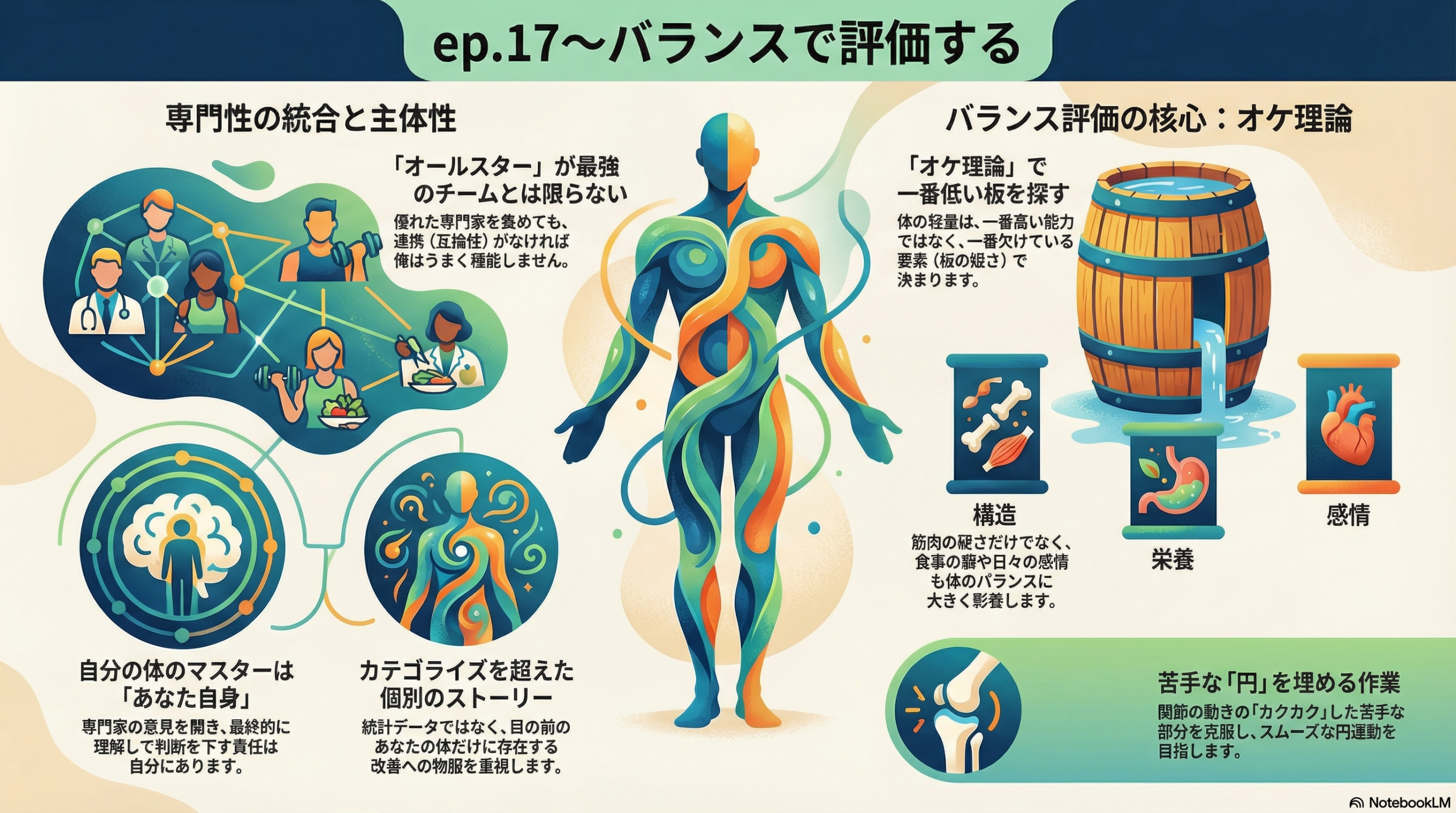
ホストは、人間を統計や属性(性別、年齢、出身など)で分類(カテゴライズ)して評価することに対し、否定的な見解を示しています
• 個性の無視: 構造やデータだけで人を判断しても、目の前の個人(クライアント)には当てはまらないことが多いと述べています。山登りに例え、頂上へのルートは無数にあり、その人だけの正解を見つける必要があるとしています
• 恋愛と医療の比喩:
◦ 医療: 医師が患者の目を見ずにモニター(数値)だけを見て診察することへの疑問
◦ 恋愛: 「身長や年収が条件に合うから好き」と言われても嬉しくないように、人間は「その人自身の個性」を見てほしいと願うものです。
2. 五感のバランスとコミュニケーション
前回のトピックを振り返り、五感のどれか一つだけが突出して鋭く、他が鈍い状態はバランスが悪いとしています。
• 例えば「聴覚」だけが過敏だと、相手の声質が生理的に不快なだけで、話の内容まで信用できなくなるといった弊害が生まれます。互いの五感のバランスが整っていることで、初めてスムーズな意思疎通が可能になります。
3. 「桶(おけ)の理論」と身体の仕組み
栄養学を例に挙げ、バランスの重要性を説明しています。
• 桶の理論: 桶を作る複数の板のうち、一番短い板の高さまでしか水はたまらない。同様に、特定の栄養素(ビタミンCなど)だけを過剰に摂取しても、他の必須栄養素が不足していれば、効果は低いレベルに合わせて漏れ出てしまいます。
• トレーニングへの応用: ベンチプレスで大胸筋だけを鍛えても、手首や体幹など、それを支える他の機能が弱ければ、実際の動作(押す力)としては機能しません。一部の筋肉だけが強すぎると、かえって全体のバランスを崩します。
4. 人生と「弱点」の底上げ
この考え方は、仕事や人生全体にも適用されます。
• ワーク・ライフ・バランス: 仕事だけが完璧でも、健康や時間がなければ人生の満足度は下がります。
• 結論: 人より優れている「得意な部分」を伸ばすことも大切ですが、全体の容量(パフォーマンスや健康)を上げるためには、「一番低い板(苦手な部分・マイナス要素)」を少しずつ底上げしてバランスを整えることが、怪我の予防や人生の質の向上に不可欠であると結論付けています
Evaluating based on Balance
In this episode, the host discusses the importance of evaluating things based on “Total Balance” rather than just looking at specific categories or parts.
1. Doubts about Evaluation by Categorization The host questions the validity of judging people solely based on statistics or attributes (such as gender, age, or background).
• Ignoring Individuality: Relying only on anatomical structure or data often fails to apply to the individual client standing in front of you. He compares this to mountain climbing, noting that while there is a summit (goal), there are infinite routes to get there, and one must find the correct route for that specific person.
• Metaphors of Medicine and Love: He critiques doctors who look only at monitors (data) rather than the patient. He also uses a relationship metaphor: just as being liked solely for meeting “conditions” (like height or income) isn’t satisfying, people want to be seen for their individual personality.
2. Balance of the Senses Reflecting on the previous topic of the “five senses,” he argues that having one sense that is hyper-sensitive while others are dull creates a bad balance.
• For example, if one’s “hearing” is too sharp, they might distrust someone simply because their voice tone is physiologically unpleasant. Smooth communication is only possible when the five senses are balanced.
3. The “Bucket Theory” and Body Mechanics He explains the importance of balance Law of the Minimum” (the Bucket Theory) from nutrition science.
• The Bucket Theory: The water level in a wooden bucket can only rise as high as its shortest stave. Similarly, taking excessive amounts of a specific nutrient (like Vitamin C) is ineffective if other essential nutrients are lacking; the benefits simply “leak out”.
• Application to Training: If you only develop major muscles (like the pectorals in a bench press) but have weak wrists or core stability, the body cannot function properly as a whole.
4. Life and Improving Weaknesses This concept applies to work-life balance and life in general.
• Conclusion: While it is important to extend your strengths, raising the level of your “lowest stave” (weaknesses or negative factors) to balance the whole is essential for preventing injuries and improving the overall quality of life
Backstage M3 Podcast
Backstage M3は、M3 Sports Therapyの視点から
「普段のセッションでは足りていない話/考え方や背景」をテーマに既存の方々との共通認識を深めるポッドキャストです。
また少しでもご自身のフィジカルや健康の事について興味を深めてもらえるようにという想いで
移動中の約15分で聴いてもらえる長さにしています。
下記からアクセスいただけます
各プラットフォームからの検索でも可能です 「Backstage M3」
Listen on:
-
Amazon Music
https://music.amazon.co.jp/podcasts/d43bcc59-d429-4646-a928-1198cef4d15a/backstage-m3 -
Apple Podcasts
https://podcasts.apple.com/jp/podcast/backstage-m3/id1822685324 -
Spotify
https://open.spotify.com/show/1unpo34EotzzxUfISM3r1E?si=67oD9QoiT8-QUlWARBtpag -
YouTube Music
https://www.youtube.com/playlist?list=PLoe4L3-eXkv57rBqwI8TAuRs8ZZSTPvCk